
Baguazhang Developments
Insights from practice

As you know, I also practice Internal Martial Arts. Taiji and Bagua, as well as Qigong. I consider swimming to be a form of qigong, as well. I started learning Bagua about twenty years ago, as well as a Chen form of Taiji, from a very good teacher named Frank Paolillo. A few years later, I became interested in the Hunyuan Chen Taiji style of Grandmaster Feng Zhiqiang. I began to work with a student of GM Feng, Master Yang Yang, and his students. Yang Laoshi is also a great Taiji teacher. I kept up the Bagua, but became more focused on Taiji.
Then, in 2015, I started working with my current teacher, Master Wang Fengming. Master Wang was a longtime disciple of GM Feng, and his Hunyuan Taiji. I was pleased to discover that Master Wang also teaches Bagua, and was a lineage holder under Liu Xing-Han, in Cheng style Bagua.
So, I began studying and practicing more regularly again. Master Wang once said to me, “Bagua is good for health”. Of course, I believed him, but over time, I have begun to actually experience this for myself.
Master Wang recommended a book to me, written by John Bracy and Master Liu. John is also a student of Liu. The book is called, “Ba Gua: Hidden Knowledge in the Taoist Internal Martial Art”. (John also produced the Pa Kua Chang Journal (alternative spelling) several years ago, which is available on CD-Rom).
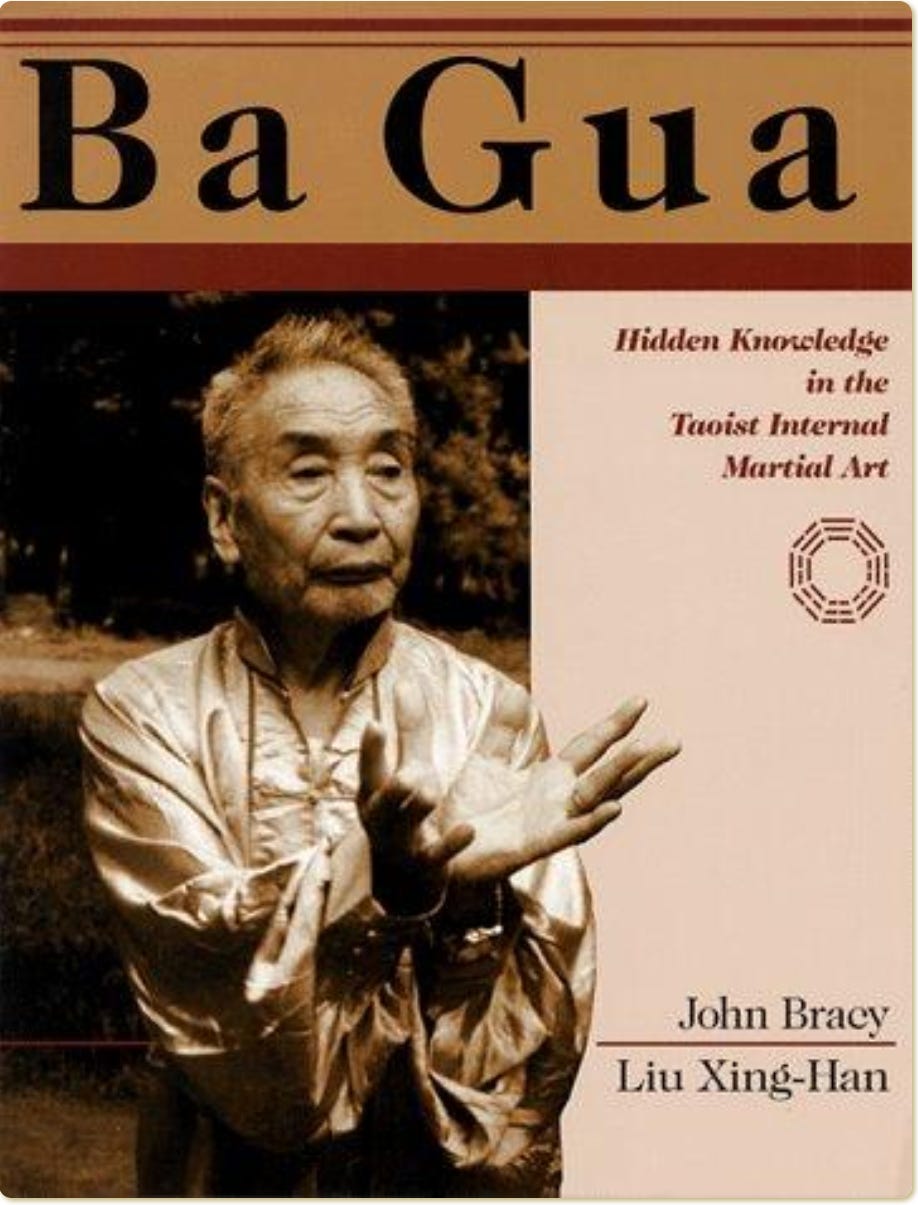
This book prompted me to reach out to John. I’ve had several conversations with him, and a few lessons. In the meantime, I learned the Bagua Qigong form described by Master Liu in the book. Over a long time of practicing Bagua, I have been noticing how things are changing in my body. This form and some of the tips I picked up from a more careful reading of the book, and from conversations with John, have really begun to produce some interesting developments.
First, the most important thing is Bagua is the stepping. There are specific things about stepping that influence everything that follows. As we walk, everything begins to turn towards the center of the circle. As we step, the outside foot and ankle have to turn in to follow the circle. The inner foot basically steps straight forward without much turning. So the turning is mainly accomplished by the outer foot. The legs need to stay close together to facilitate this, as well. Then, the upper body also turns towards the center of the circle. So, we are continually turning in towards the center of the circle. In combination with this are various hand and arm postures and movements.
An important clue that I learned from recent practice is that in stepping, we don’t shift the weight from one foot to the other until we are ready to pull ourselves forward with the forward foot. This is a little tricky at first, but it begins to feel more natural. The turning towards the center begins to involve the whole spine, from the perineum, Hui Yin, to the crown of the head, Bai Hui. It is quite interesting and inspiring to have insights about practice and see how it’s progressing.
The combination of the variety of circle sizes and the different postures introduced in the new qigong form, and the improvement in the stepping is really changing my practice. I was surprised to feel subtle adjustments in my spine while walking. This is one obvious result. I also feel an improvement in the core strength of my body and my overall posture. Master Wang was right when he said that Bagua is good for health!
It’s also interesting that some of these developments in Bagua have paralleled some improvements in swimming. I think it’s also affecting my piano playing. How can it not, if it involves balance and posture, in body and mind?
I’ll keep you posted.
Good stuff, Keith